

The Sorek Valley: The Modern-Day Location Of The Story Of Samson
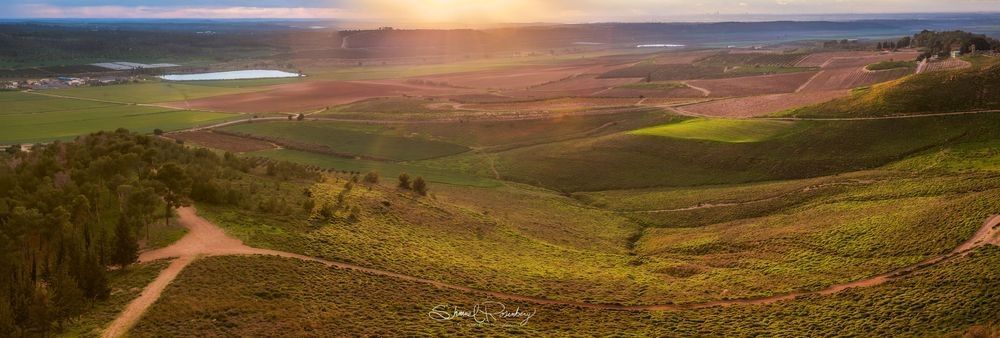
There is a valley in the heart of Israel that most people drive past without stopping. It sits between the Judean foothills and the coastal plain, a few kilometers east of where the land flattens out toward the sea. Vineyards cover its hillsides. A biblical river runs through its floor. Reservoirs catch the winter rains and hold them through the long dry summer. In the evenings, when the light comes in low from the west, and the mist settles in the low ground between the hills, it looks like the kind of place that has always been here and always will be.
It's called the Sorek Valley. And if you know your Tanach, you know that almost everything that happened here is a story about the cost of living on the border between two worlds.
Born On The Border
The Book of Judges tells us that a man named Manoach lived in Tzorah, in the territory of the tribe of Dan. He and his wife had no children. One day, an angel appeared to the woman and told her she would conceive a son, and that this son was to be a Nazirite from birth — consecrated to God, his hair never cut, no wine ever to touch his lips. He would begin the work of delivering Israel from the Philistines, who had dominated the land for forty years.
The son born from that promise was Shimshon. Samson.
Tel Tzorah sits at the northern edge of the Sorek Valley, on a ridge that looks out over the entire region. When you stand up there and look west, you see everything immediately. The Philistine coastal plain begins where the hills end, just a few kilometers away. The valley between the Israelite highlands and the Philistine lowlands was the frontier — close enough for trade, close enough for trouble, close enough for a young man with too much strength and not enough caution to keep crossing back and forth until it destroyed him.
A Man Of Two Worlds
The story of Samson is one of the most psychologically complex in all of Tanach, and it tends to be flattened by familiarity. We remember the superhuman feats — the lion torn apart bare-handed in the vineyards of Timnah, the foxes sent through the Philistine grain fields with torches tied to their tails, the gates of Gaza carried on his shoulders to the top of a hill, the final act of pulling down the pillars of the Philistine temple with three thousand people on the roof. We remember Delilah and the haircut. We remember the tragedy.
What gets lost is the man underneath all of it.
Samson was born into a calling he never fully accepted and never fully rejected. He was a Nazirite, set apart, but he spent his life moving toward the world he was set apart from. He wanted a Philistine wife. He attended Philistine feasts. He fell in love, repeatedly, on the wrong side of the border. His parents pleaded with him. The text records their objections with quiet anguish. Samson's answer is always some version of the same thing: this is what I want. Get her for me.
The rabbis have read this in different ways. Some see a man undone by desire, his spiritual gifts wasted on personal indulgence. Others argue that everything Samson did was in some sense divinely directed — that his relationships with Philistine women were not weakness but strategy, creating the provocations that gave him pretext to strike against the enemy. That God was working through even his worst impulses to accomplish what needed to be accomplished.
Both readings feel true. That tension is what makes Samson unlike almost any other figure in Tanach. He is a man about whom you cannot be simple.
The Vineyards
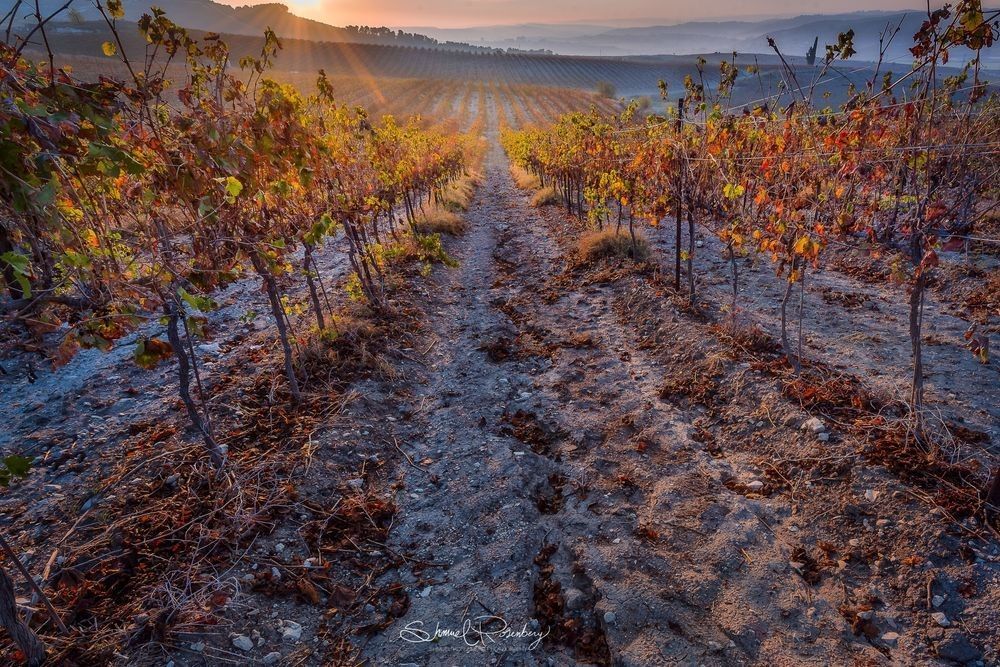
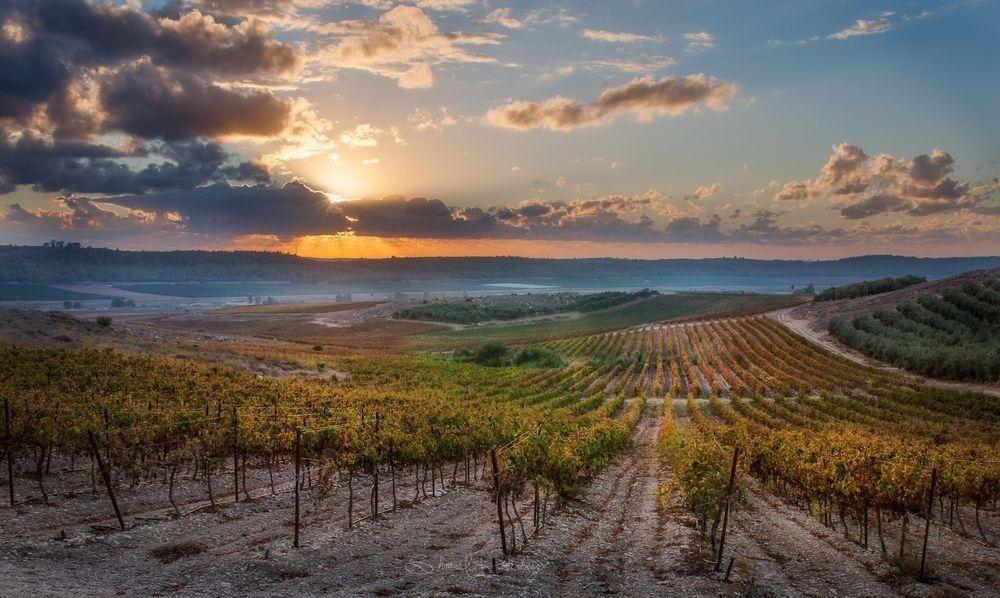
The valley is called Sorek because in Hebrew, Sorek refers to a quality grapevine, and for thousands of years, it has been the location of some of Israel's best vineyards. The valley is wine country, and it was wine country in Samson's time too, which is part of why his story is saturated with vineyard imagery. It is in the vineyards of Timnah, just down the valley from Tzorah, that the lion attacks him. It is among the vine rows that he discovers the honeycomb in the lion's carcass on his return journey, giving him the riddle that sets off the chain of events leading to his first marriage and his first war with the Philistines.
In the Book of Judges, vineyards are liminal spaces. They are productive and beautiful, but they are also the places where boundaries dissolve, where the unexpected happens, where a man traveling between his world and another world encounters things that change him. Samson's life keeps bringing him back to the vines.
When I photograph these hillsides at golden hour in autumn, with the leaves turning red and gold and the morning mist still sitting between the rows, the connection between the landscape and the story becomes visceral. These are not abstract biblical vineyards. They are here, growing in the same soil, lit by the same light, shaped by the same seasons that shaped everything Samson ever experienced.
The River
The Nahal Sorek — the Sorek Stream — runs through the floor of the valley from east to west, originating in the Judean Hills near Jerusalem and flowing all the way to the Mediterranean. In biblical times it would have been the main corridor through this region, a natural highway and a natural boundary. The valley is named for the vine, but the river is the valley's spine.
The Sorek appears by name only once in the entire Samson narrative, but it is the most significant appearance of any place in the story. The text says: "After this he loved a woman in the valley of Sorek, whose name was Delilah." That's it. No other introduction. No background on Delilah, no explanation of how they met or what drew Samson to her. Just: he loved a woman. In the valley of Sorek. And her name was Delilah.
Everything the reader needs to know is in the geography. He came back. Again. To the borderland. To the valley between his world and theirs. To the place that had already cost him everything once.
I have photographed the Sorek River many times, in different seasons and different conditions. In winter and spring, after the rains, it runs fast and full, white water churning around the large limestone boulders in its bed, the banks thick with vegetation. In summer, it slows and narrows. But it always moves in the same direction — westward, toward the sea, toward Philistine territory, in the same direction Samson kept walking.
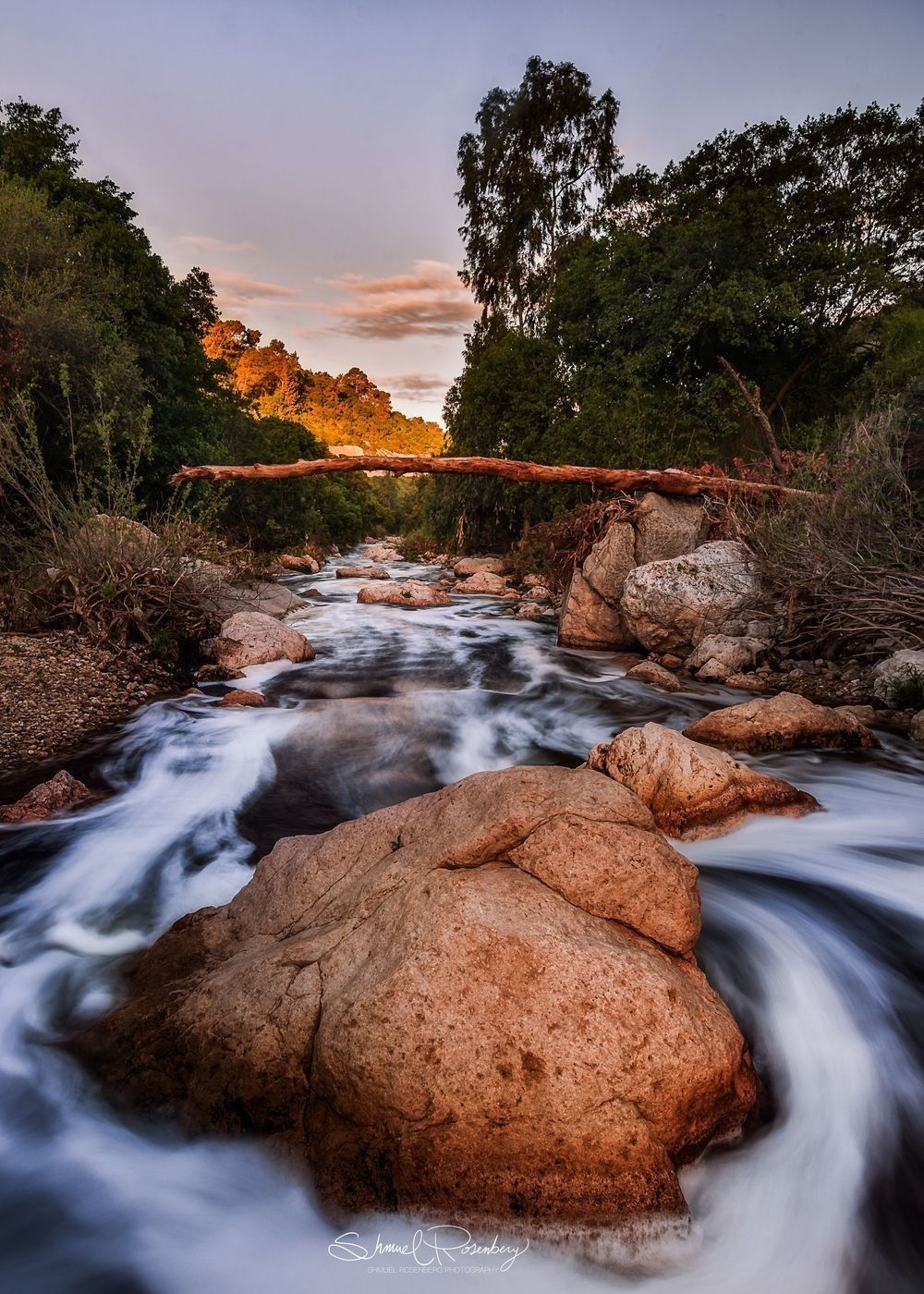
There is something about standing at the river's edge and watching it move that brings the story into focus in a way that no amount of reading does. The water flowing past you has been flowing past this spot for thousands of years. It flowed past when Delilah lived on its banks. It flowed past when the Philistine lords came to her house with eleven hundred pieces of silver each and told her to find out where Samson's strength lay. It was flowing the morning after she finally succeeded, when Samson woke to find his strength gone and his enemies upon him.
And today, we can see and explore this very same streambed, still flowing, carrying thousands of years of history with it.
The Reservoir At Evening
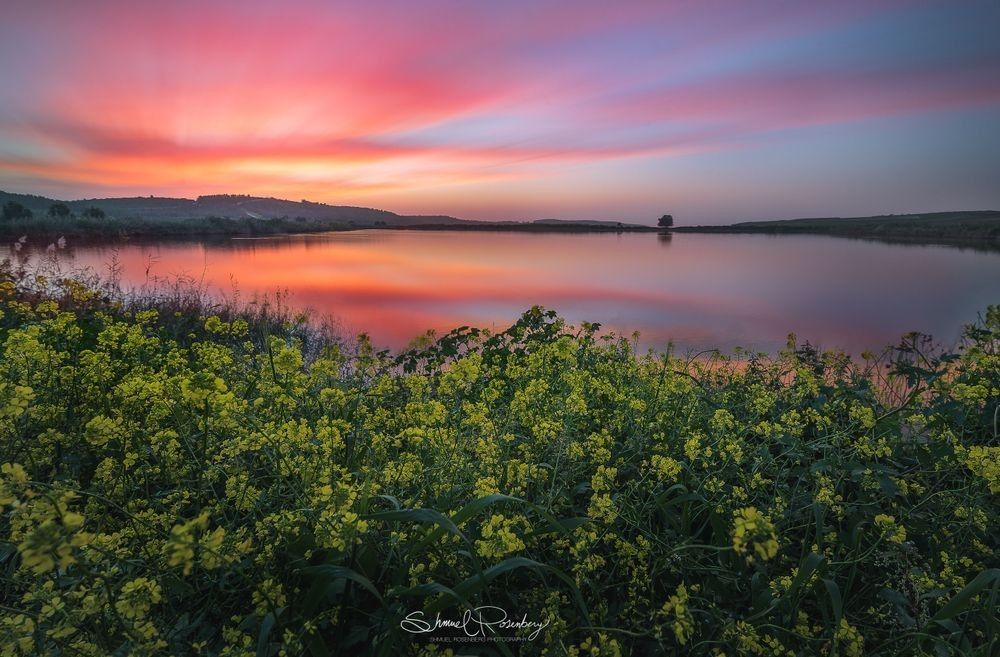
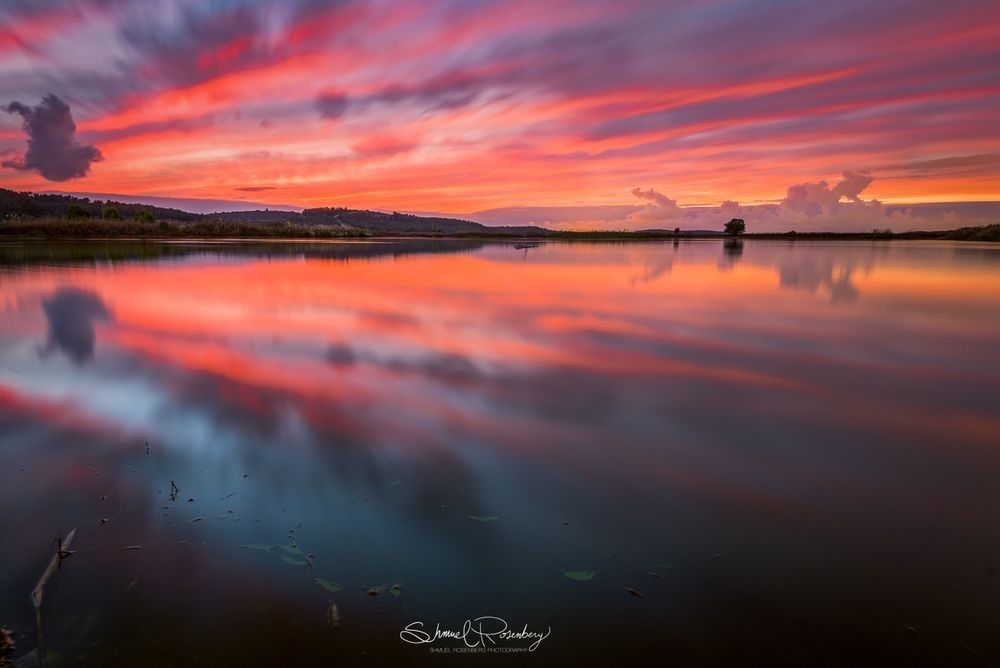
The large reservoir that sits in the valley floor is one of the most photographed spots in the region, and it earns every photograph. In the right conditions — a dramatic sunset, still air, the water like glass — it doubles the sky perfectly, and the boundary between above and below disappears. The world folds in on itself. What was the sky is now the water, and you can no longer tell which way is up.
I keep coming back to this spot because it never gives me the same image twice. Some evenings the sky goes pink and soft, with wildflowers on the bank catching the last warm light before it fades. Others, it erupts in crimson and orange, the whole vault of the sky on fire, the reflection below burning just as hot as the original.
The End And What Remains
The story ends in Gaza, far from the Sorek Valley. Samson, blinded and imprisoned, is brought out to perform for the Philistines at a feast in the temple of Dagon. He asks the boy leading him to place his hands against the pillars. He prays — the only time in the narrative he prays with full sincerity, without conditions, without the posturing that characterized his earlier dealings with God. "Remember me, and strengthen me only this once."
And then he pushes.
The temple comes down. Three thousand people die, including Samson himself. The text notes, with an almost understated gravity, that those he killed in his death were more than those he killed in his life.
His brothers and his father's household came and took him back. They buried him between Tzorah and Eshtaol, in the burial ground of Manoach, his father. On a hilltop above the Sorek Valley, among pine trees, where you can look out over the vineyards and the river and the reservoir and the coastal plain beyond, and see everything he ever wanted and everything he ever came from in a single glance.
The grave is still there. Or at least, a site that tradition has long associated with his memory is still there, on that hilltop, among those trees. Whether or not the identification is certain matters less than the instinct behind it. Someone, a very long time ago, understood that he belonged here. That this valley, with its vines and its river and its border light, was his place. And they brought him back to it.
Coming Here
In modern times, the Sorek Valley receives almost no international tourism. The Israel Railways line to Jerusalem passes through it, and the train ride through the valley is genuinely one of the most beautiful in the country, but most people are looking at their phones. The local wineries serve amazing wines alongside cheese platters and gorgeous views. The hiking trails along the river are accessible and quiet.
It is the kind of place that rewards people who come specifically to be in it rather than to check it off a list. Come in autumn when the vineyard rows are turning. Come at dawn when the mist is still sitting in the low ground, and the reservoir is perfectly still. Come at golden hour when the light sweeps in from the coast and turns everything it touches to warm gold.
Come knowing the story. Because when you do, the landscape stops being scenery and starts being testimony. Every vine row and every bend in the river and every reflection in the reservoir is evidence of something that happened here, something that is still happening here in some sense, something that the land absorbed and held and has been holding ever since.
The Sorek Valley is one of those hidden gems in Israel that once discovered, you'll keep on coming back to see and experience more of it.
Fine-art photographs from the Sorek Valley and other hidden corners of Israel are available as wall prints on my website.